

Every founder I talk to asks this question at some point. "What should we build this on?" If you Google it, you'll get 50 different answers from developers who each swear their favorite tool is the right one. Ruby fans push Rails. Go enthusiasts push Go. The Python crowd has opinions. It gets confusing fast, especially if you don't come from a technical background.
After years of building products, here's what I've learned: for most startups shipping their first product, this decision is way less complicated than the internet makes it sound.
The short answer
Pick JavaScript/TypeScript for everything. Seriously.
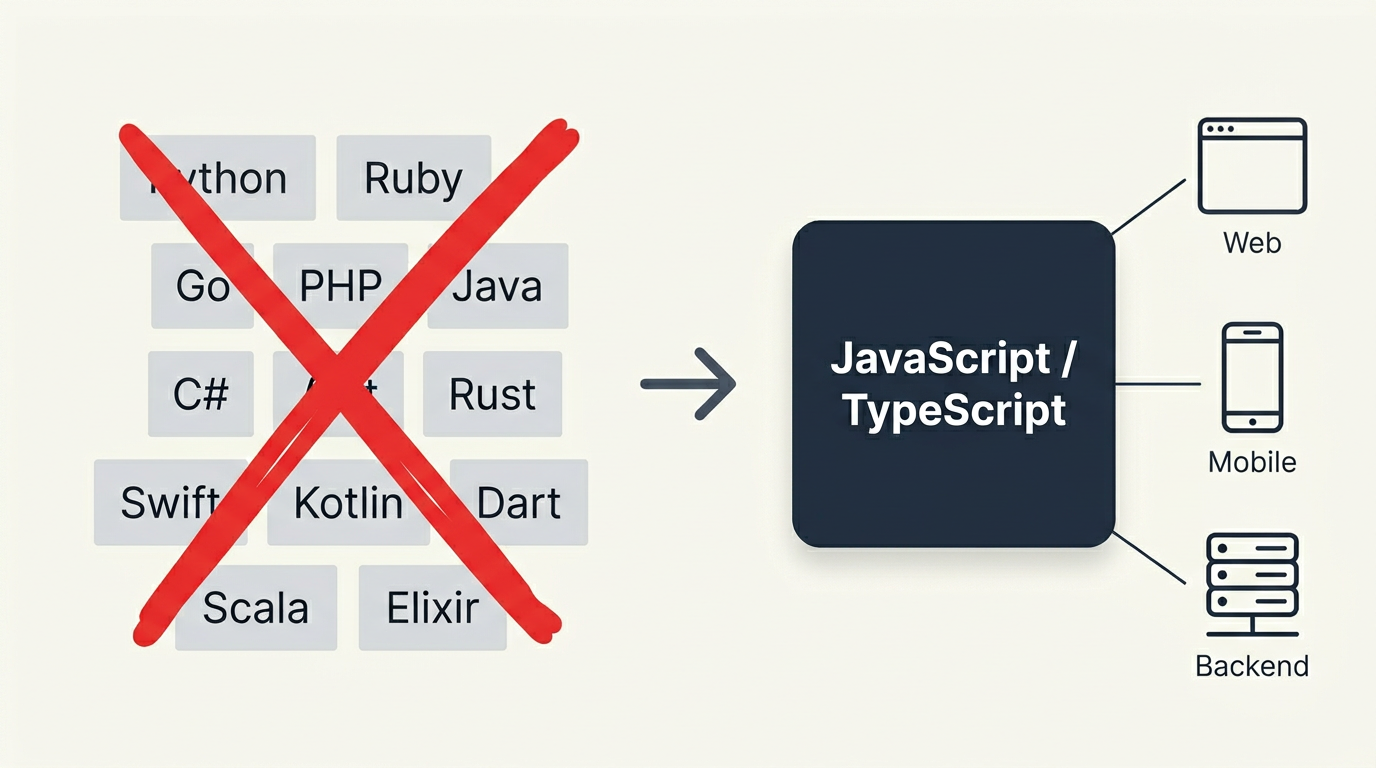 Skip the language wars. One language across web, mobile, and backend.
Not because it's the "best" language in some abstract sense. Developers will argue about that until the heat death of the universe. But because it solves problems that matter when you're building a startup.
One language across your entire product. Your website, your backend API, your mobile app, your admin dashboard, all written in the same language. That means any developer on your team can work on any part of the system. It means shared code between frontend and backend. It means when you hire, you're looking for one skill set instead of three.
The biggest ecosystem. npm (the package registry for JavaScript) has more packages than any other language ecosystem. Whatever you need to build, someone has probably built a library for it.
Easy to hire for. JavaScript is the most widely known programming language in the world. That matters when you're competing for talent against companies with bigger budgets.
What does a TypeScript stack actually look like?
Let me be specific.
For your web app: Next.js. This is a framework built on top of React (the most popular UI library in the world). It handles routing, server-side rendering, and a bunch of infrastructure you'd otherwise have to build yourself. Almost every React developer already knows it or can pick it up fast.
For your backend: Node.js with Express or NestJS. Node.js runs JavaScript on the server. Express is lightweight and flexible. NestJS adds more structure if your backend gets complex. Either works. For most MVPs, Express is plenty.
For mobile: React Native. One codebase, two apps (iOS and Android). There are other cross-platform options out there (Flutter/Dart, Kotlin Multiplatform), but React Native has a unique advantage: your mobile developers write the same language as your web and backend team. No context switching, no hiring a separate skill set. And the React Native ecosystem is mature enough that most standard mobile features are well-supported out of the box.
For machine learning: Python. This is the one exception. If your product involves actual ML model training (not just calling OpenAI's API), then Python is the right tool for that specific job. The ML ecosystem in Python is years ahead of everything else, and no amount of JavaScript enthusiasm changes that. But notice this is an addition to your core stack, not a replacement.
The AI advantage
If your entire codebase is in one language, AI coding tools work dramatically better.
When an AI assistant looks at your code, it builds context from what it sees. If it's looking at TypeScript on the frontend, TypeScript on the backend, and TypeScript in your mobile app, it understands the full picture. It can see your database schema, your API types, and your UI components in one coherent context.
Mix three different languages and the AI has to context-switch constantly. It makes more mistakes. It suggests patterns from the wrong ecosystem. It gets confused about which conventions apply where.
If you're planning to use AI tools in your development process (and in 2026, you probably should be), a unified tech stack gives you a measurable productivity edge.
Watch out for versions
One thing that trips up even experienced teams: framework versions. And this is especially tricky if you're leaning on AI tools to help build your product.
AI models are trained on data with a cutoff date. They might default to patterns from an older version of a framework without telling you. I've seen this firsthand. A team asked their AI tool to work with "the latest version of YOLO" (a popular computer vision library). The AI confidently started writing code for YOLO11. The actual latest version at that point was v26. That's not a small gap.
The fix is straightforward but easy to forget: always check the current version yourself. Go to the official documentation, note the version number, and explicitly tell your AI tool which version to target. Don't delegate version selection to AI. AI consistently gets this wrong. At least with me.
What NOT to do
A few patterns I see regularly that waste money and time:
Don't use microservices for your MVP. Microservices are for companies handling millions of requests with large engineering teams. For your first product with a few hundred users, a single application (a monolith) is faster to build, easier to debug, and cheaper to run. You can always split it later if you need to.
Don't pick "cutting-edge" technology. That new framework with 500 GitHub stars might sound exciting, but good luck finding developers who know it, or getting help when something breaks at 2 AM. And if you're using AI tools to help build, they won't know it either. AI models learn from existing code, and a niche framework simply doesn't have enough examples out there for the AI to be useful. Boring technology is a feature when you're building a business.
Don't let a developer pick based on personal preference. "I want to learn Rust" is a valid personal goal. It's not a valid reason to build your startup's MVP in a language with a steep learning curve and a smaller hiring pool. Your tech stack should serve the business, not the resume of whoever you hired first.
Don't over-optimize for scale you don't have. You're not Twitter. You're not Netflix. Build something that works for your first 1,000 users. When you have 100,000 users, you'll have revenue to re-architect the parts that need it. Most startups fail from building too slowly, not from success they couldn't handle.
When does this advice NOT apply?
The JavaScript-everywhere approach works for probably 80% of startups, but there are real exceptions.
If your product is computationally heavy (real-time video processing, high-frequency trading), you might need something faster than JavaScript. If your entire product IS a machine learning model, Python becomes your primary language, not just an addition. If you're building embedded systems or hardware interfaces, different rules apply.
Ship fast, change later
Don't agonize over this decision.
Yes, picking the right stack matters. But what matters more is shipping. Validating. Getting real users in front of real software. The number one cause of startup failure isn't a wrong tech stack, it's building something nobody wants.
The whole reason JavaScript everywhere works so well is precisely because it lets you move fast. One language, huge ecosystem, AI tools that work great with it, easy hiring. Pick it, ship in weeks, see if anyone cares. If your product takes off and you discover that one piece of it really needs to be in Go or Rust for performance reasons, great problem to have. You'll have the revenue to rewrite that piece.
Most startups never get to the rewrite. Not because their stack was bad. Because they never proved anyone wanted what they were building.
So pick the stack, ship the thing, learn from real users. The cost of being slow to launch is way higher than the cost of switching technologies later.
There are decisions that are harder to undo than picking a framework. How you structure your data, how you handle authentication, how you set up payments, what you do about user data and GDPR. Those need someone with experience the first time around. If you're a non-technical founder, get a technical person in your corner for those calls.